
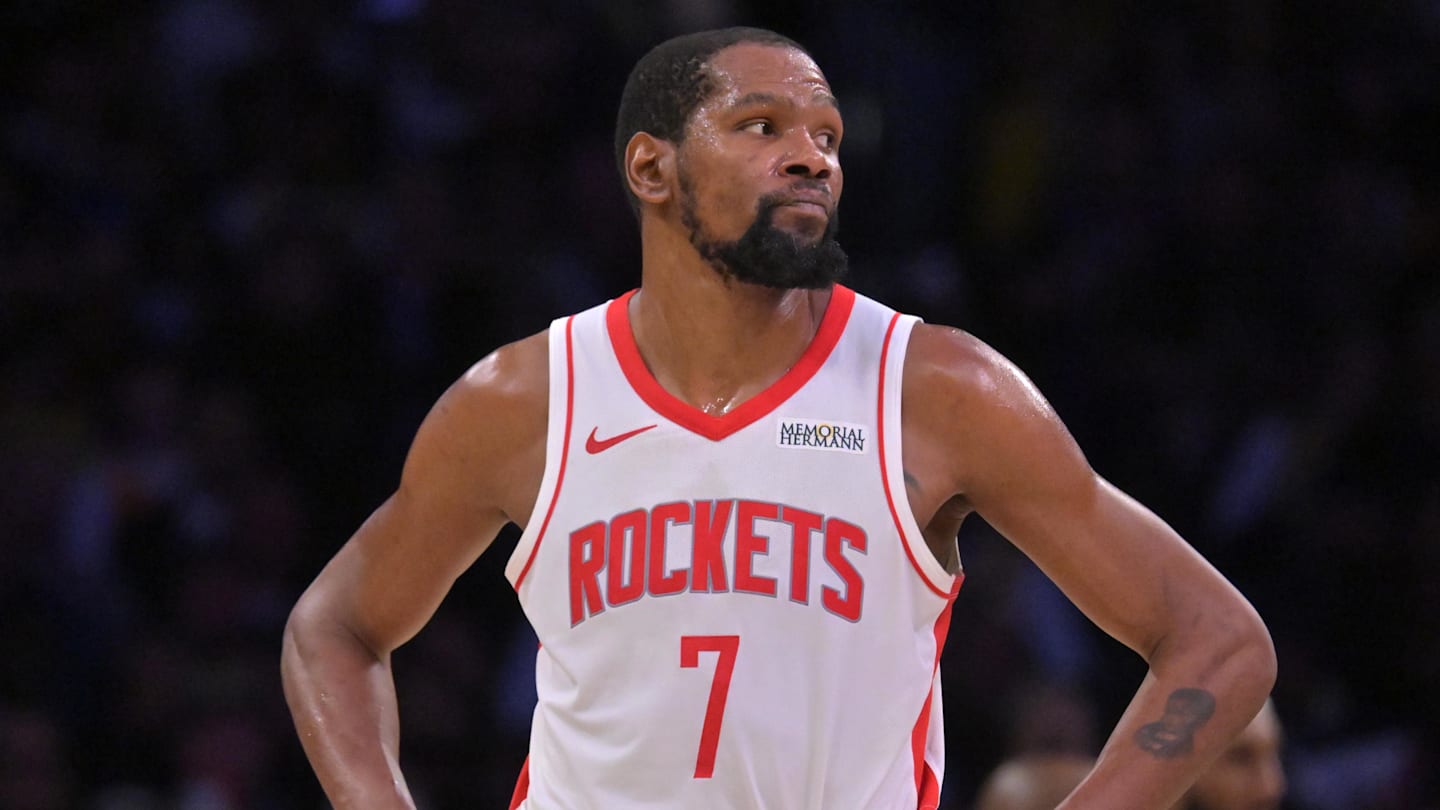
The Houston Rockets made a clear bet. They did not just add Kevin Durant, they built around him, believing his presence would solve the problems that held them back a season ago.
Now, two games into a playoff series they were expected to control, that bet is already under pressure.
The Rockets trail 0-3 against a Lakers team missing both Luka Dončić and Austin Reaves, a situation that should have tilted the series firmly in Houston’s favor and, realistically, should have them up 2-0. Instead, it has exposed something far more concerning.
Even Kevin Durant hasn't been enough to help the Rockets
Durant missed Game 1, and Houston struggled without him, which was expected. The assumption was that his return in Game 2 would rebalance the series and restore control to the Rockets. It did not.
Houston still came up short, and not because Durant failed, but because his presence did not change the underlying issues that continue to define this team. He can raise the ceiling of a possession, but he cannot stabilize a system that repeatedly breaks down in key moments. That distinction is becoming painfully clear.
The Rockets were supposed to have addressed their biggest weaknesses. Instead, they are watching them reappear in the most critical stretch of the season.
Execution still slips when the pace slows. Ball movement still disappears in late-game situations. The offense still leans too heavily on isolation, now centered around Durant, without creating the kind of structure that holds up under pressure.
And defensively, something even more troubling is happening. Houston is allowing role players to become stars overnight, something that rarely happens by accident in the playoffs.
The Los Angeles Lakers exposed a deeper Rockets issue
This series is not being decided by superstars alone. It is being shaped by players Houston should be able to contain.
Marcus Smart, returning from injury and known primarily for his defense, suddenly looked like a scoring threat. Luke Kennard, typically a low-volume but efficient shooter, caught fire and stretched the defense to its limits.
He's turning clean looks into momentum-shifting runs that Houston never fully recovered from. LeBron James and JJ Redick have clearly set the stage, creating an environment where role players understand their responsibilities and can thrive within a defined structure.
The Lakers are not just surviving without key players; they are functioning, and that is what makes the difference. Houston, by contrast, is reacting rather than controlling.
Kevin Durant cannot fix what the system does not support
Durant can carry stretches of games. He cannot fix everything around him. That is the reality Houston is now confronting. Relying on a 38-year-old to solve execution issues, stabilize the offense, and compensate for defensive lapses is not a sustainable formula, no matter how great that player still is.
Because when role players on the opposing side are outperforming expectations this dramatically, it points to something deeper than individual matchups. It points to a system that is not holding up. And that is not something Durant alone can change.
Being down 0-3 is one thing. Being down 0-3 to an undermanned team while the same issues from last season resurface is something else entirely. This is not about a slow start. It is about a pattern.
Houston made the move it believed would propel it forward, but the early signs suggest the foundation beneath it was never fully repaired.
If that remains the case, then the addition of Durant does not solve the problem. It only delays the moment when it has to be addressed. Right now, that moment has arrived far sooner than expected. They might fall into a 0-3 hole.